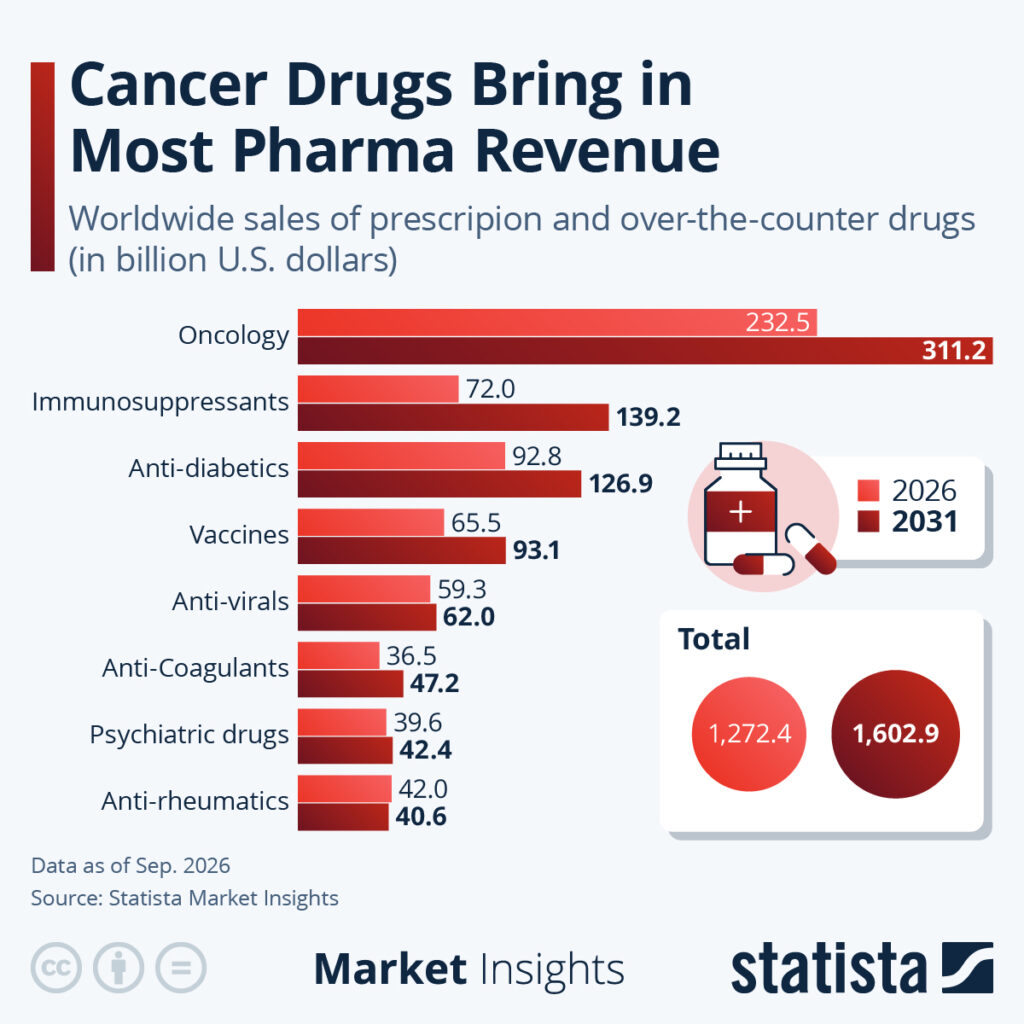
Global cancer medicine sales are forecast to reach approximately £235 billion a year by 2031, highlighting the expanding commercial scale of oncology and the growing challenge of funding access to treatment.
Statista Market Insights estimates worldwide oncology drug revenues at approximately £175 billion in 2026. Its forecast points to growth of around 34% over five years, with cancer medicines approaching one-fifth of global pharmaceutical sales by 2031.
For healthcare providers, pharmaceutical developers and investors, the figures raise a shared question: how can expanding investment in medicines translate into affordable, deliverable improvements in patient care?
 Oncology’s Lead Reflects a Growing Healthcare Challenge
Cancer medicines generate substantially more revenue than any other drug category in Statista’s comparison.
For 2026, the estimated oncology market is roughly two-and-a-half times the size of the diabetes medicines market, which stands at approximately £70 billion. Immunosuppressants account for around £54 billion, while vaccine revenues are estimated at approximately £49 billion.
These figures measure commercial sales rather than clinical importance, patient numbers or treatment success. Nevertheless, they demonstrate the financial weight of cancer treatment within the pharmaceutical sector.
The underlying disease burden remains substantial. The International Agency for Research on Cancer estimates that 20.6 million people were diagnosed with cancer worldwide in 2024, with annual diagnoses projected to reach 34.4 million by 2050.
That trajectory has implications extending beyond pharmaceutical budgets to diagnostic services, specialist staffing and treatment capacity.
Medicines Spending Is Only Part of the Resource Requirement
For healthcare leaders, a growing medicines market should prompt planning across the entire treatment pathway.
A new therapy may require additional diagnostic testing, specialist prescribing, pharmacy preparation, administration appointments and monitoring. Assessing its practical impact therefore requires consideration of both the medicine and the services needed to use it.
A treatment offering meaningful clinical benefits can still create operational pressure if hospitals lack the capacity to identify eligible patients or deliver care promptly.
For organisations evaluating investment priorities, this suggests a need to examine where additional resources would remove barriers to treatment. Depending on local circumstances, the most useful investment could involve laboratory capacity, pharmacy services, workforce development or better coordination between care settings.
Demonstrating Value Will Remain Essential
Revenue forecasts do not establish whether individual medicines represent good value for healthcare systems.
NICE’s technology appraisal process considers clinical effectiveness alongside cost effectiveness when making recommendations for the NHS in England. The distinction matters: evidence that a medicine works must be considered together with the benefits it delivers relative to its costs and existing treatment options.
For developers, the commercial implications are clear. Evidence generation needs to address the questions healthcare purchasers will ask, including which patients benefit, how outcomes compare with established care and what adopting the treatment means for service delivery.
For investors, those same questions help distinguish scientific promise from a credible route to sustained use.
Aligning Commercial Growth With Patient Benefit
The analysis points towards a larger oncology market, but its value to healthcare will depend on what that spending achieves.
Healthcare organisations need to assess whether new treatments improve survival, quality of life or the experience of care, while remaining practical to deliver. Investors need to understand whether those benefits can support adoption within constrained budgets.
The strongest alignment between the two will come where convincing clinical evidence, workable delivery and affordable access reinforce one another.
Currency note: Sterling figures are approximate conversions of US-dollar estimates using £1 = $1.3253, the reported Bank of England rate for 15 October 2026. The same rate is applied to both forecast years for comparison; these are not forecasts of future sterling revenues.
Sources: Statista: Cancer Drugs Bring in the Most Pharma Revenue — October 2026 update.
IARC: Global Cancer Statistics 2024.