Merck & Co’s growing portfolio of treatments outside oncology could help offset a steep decline in sales of its cancer drug Keytruda as patent protection expires, according to analysis from GlobalData.
The intelligence company forecasts that Keytruda revenues will fall by 57% between 2025 and 2032. Over the same period, sales from Merck’s non-oncology portfolio are expected to more than double, reducing its dependence on a medicine that has accounted for over half of total company revenue in each of the past three years.
Keytruda, also known as pembrolizumab, is an immune checkpoint inhibitor first approved by the US Food and Drug Administration in 2014. It has subsequently secured approvals across more than 40 oncology indications.
According to GlobalData, the drug generated sales of $31.7 billion in 2025, representing 58% of Merck’s total sales. However, US market exclusivity is expected to expire in 2028, followed by Europe in 2031 and Japan in 2033.
GlobalData forecasts that Keytruda sales will decline to $13.6 billion by 2032, creating a substantial gap for other products to fill.
Treatments Outside Oncology Take a Larger Role
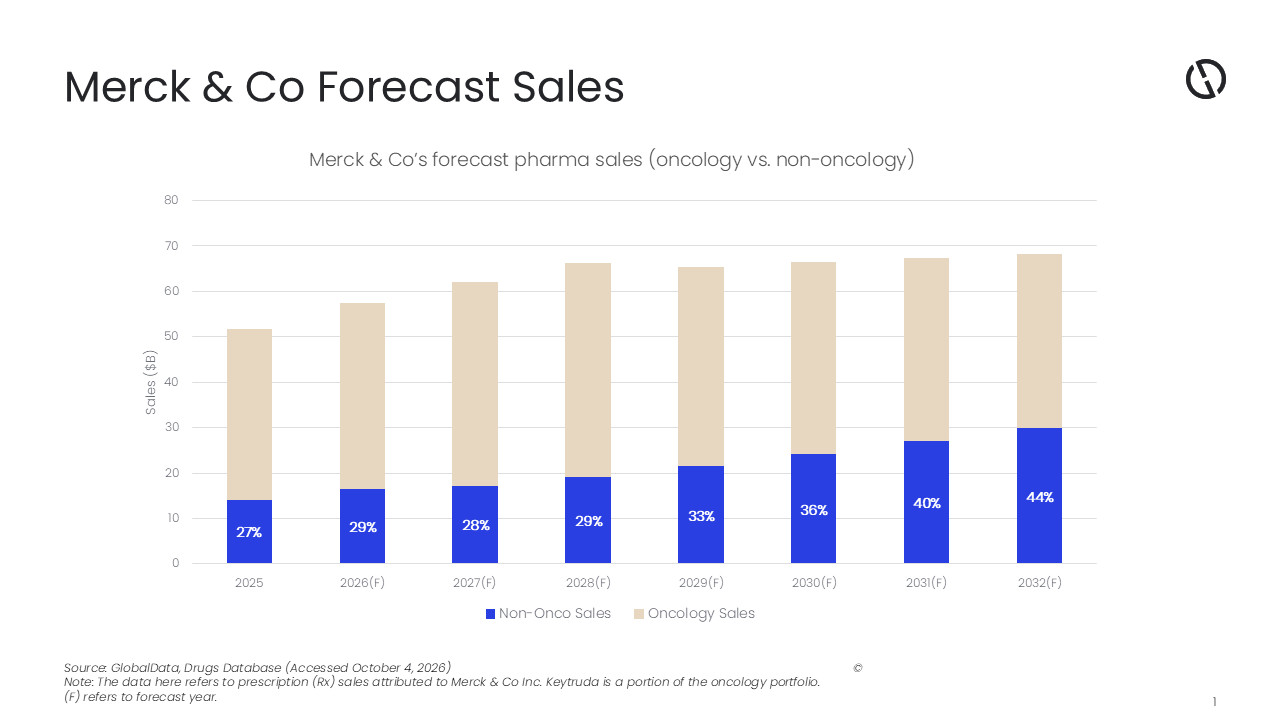
Merck’s non-oncology portfolio generated $14.1 billion in 2025, accounting for 27% of its pharmaceutical sales of $51.8 billion. Oncology contributed the remaining $37.7 billion.
Jasper Morley, Pharma Analyst at GlobalData, comments: “Sales from Merck’s non-oncology portfolio are expected to double between 2025 and 2032, ultimately reaching $29.9 billion and accounting for 44% of the company’s total forecast pharma sales of $68.4 billion.
“This growth is expected to be driven by six non-oncology therapy areas, with infectious disease remaining as the largest contributor. Having generated $5.8 billion in 2025, infectious disease sales are forecast to increase by 54% to $9.1 billion by 2032.”
Established vaccines are expected to remain important contributors. GlobalData forecasts that ProQuad will generate $2.77 billion in 2032, despite having lost market exclusivity in 2016.
The analysis also identifies MK-1406, a Phase III seasonal influenza vaccine candidate, as a potential future contributor. GlobalData anticipates a launch in 2027 and sales of $1.86 billion by 2032, although the product remains investigational.
Winrevair Expected to Drive Cardiovascular Growth
Cardiovascular medicines are forecast to become Merck’s fastest-growing therapy area, with sales rising from $1.76 billion in 2025 to $7.76 billion in 2032.
Much of that growth is expected to come from Winrevair, which was approved in 2024 for the treatment of pulmonary arterial hypertension.
Following sales of $1.4 billion in 2025, GlobalData forecasts that Winrevair will reach $6.9 billion by 2032. That would make it responsible for approximately 89% of Merck’s cardiovascular sales.
Oncology is nevertheless expected to remain the company’s largest pharmaceutical therapy area. Supported by the subcutaneous version of Keytruda and anticipated product launches, oncology sales are forecast to reach $38.5 billion in 2032.
That represents growth of just 2% from 2025, compared with a 104% increase between 2020 and 2025.
Morley concludes: “Overall, Merck’s expanding non-oncology portfolio is expected to play an increasingly important role in cushioning the impact of Keytruda’s patent cliff. While oncology is expected to remain Merck’s largest therapy area by 2032, the expansion of non-oncology sales will reduce the company’s reliance on Keytruda and provide a more diversified revenue base.”
Sources/References
GlobalData — supplied analysis of Merck’s pharmaceutical portfolio and sales forecasts. All revenue projections and analyst quotations are attributed to GlobalData.